A long read · Consumer Brands · Cities
Yum earns trust by taking things away
A register of 1,085 celebrated restaurants in 218 cities that deleted every field it could not stand behind. We counted it, and set it beside the Michelin Guide and the World's 50 Best.
By the LABS editorsTested 27 September 2026, 19:58–20:02 UTCA 4-minute read800 words
Chapter one · What it is
A shortlist of celebrated rooms
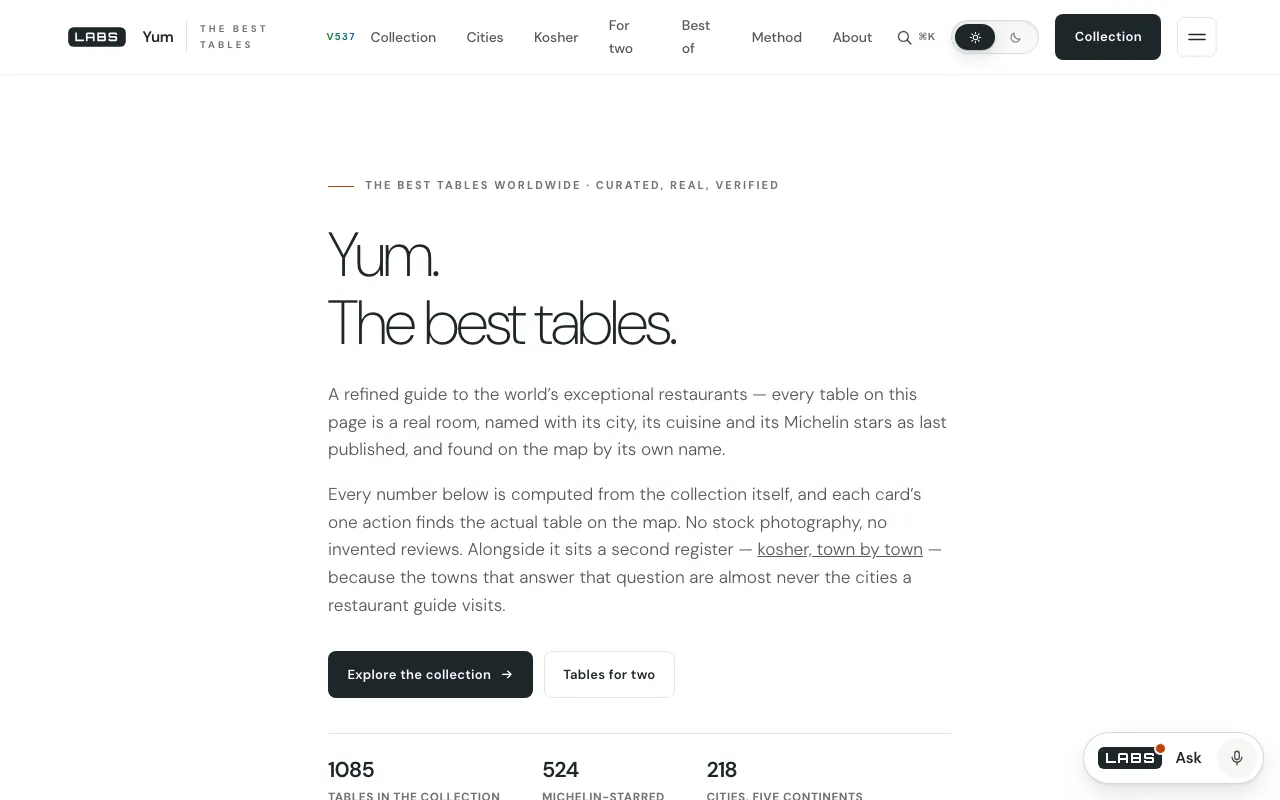
Yum is a guide to notable restaurants around the world: 1,085 of them in 218 cities and 51 countries, drawn from the consensus of the Michelin Guide, Eater and the World's 50 Best. You can search it by name, city, cuisine and Michelin stars, have 'tables for two' dealt at random, and read best-of lists the page works out for itself. A separate register of 518 kosher restaurants sits alongside.
It is for travellers and diners planning a special meal who want an uncluttered shortlist by city and stars — and for anyone hunting for kosher tables in a strange town.
Chapter two · How it works
Two files, and a list of things removed
Yum runs in your browser from two static JSON files served next to the page, each fetched once; every count, filter, sort and list is computed from them.1 The script's header records why that matters: an earlier version of the page claimed 671 restaurants and quietly served 315.
The more unusual story is what is missing. When the register was audited in August 2026, the fields nobody could vouch for were deleted: the older dataset's ratings, review counts, price bands and street addresses.2 Each card now links to a Google Maps search on the restaurant's name, city and country rather than an address that might be wrong, and the best-of lists rank only by stars and place, because the old ratings had been generated rather than gathered.3
The kosher register is kept deliberately apart from the main collection, in a file of its own.
Chapter three · The test
Counting the register
We loaded the page from a local copy of build 537 at 19:58:54 UTC on 27 September 2026, and downloaded both files at the same moment. The main file was 362,156 bytes and held 1,085 records across 218 cities and 51 countries. Stars broke down as 139 three-star, 129 two-star and 256 one-star rooms, with 561 carrying none. The kosher file held 518 records.4
Each record has a name, city, country, neighbourhood, cuisine, tags, a star count and a one-line description. There is no address, no date and no source on any record. The United States accounts for 657 records; France has 48, the United Kingdom 47, Italy 32 and Japan 31.
Chapter four · Against the field
The Michelin Guide and the World's 50 Best
The MICHELIN Guide
Page read 27 September 2026, 20:02 UTC
Michelin's own selection listed 19,745 establishments when we looked, filterable by distinction — 162 with three stars, 545 with two, 3,175 with one and 3,747 Bib Gourmands — and by cuisine, price, dietary needs and services, with photographs and a 'Reserve a table' button.
Where it is betterIt is the primary source for stars, it is vastly larger, and it helps you actually book, with prices and pictures.
Where Yum goes furtherIt brings restaurants the stars do not cover into the same search — 561 of its 1,085 records carry no stars, with a 'Beyond the guide' list — and it keeps a 518-strong kosher register on the same page.5
The World's 50 Best Restaurants
Page read 27 September 2026, 20:02 UTC
The annual list ranks fifty restaurants, with an extended 51 to 100, each named with its city, plus individual awards; registered users can save venues and build their own lists. The old theworlds50best.com address now redirects to the50.com.
Where it is betterIt is a ranked list, set beside individual awards, which Yum does not attempt.
Where Yum goes furtherIt is searchable across 218 cities by name, cuisine and stars, with every figure computed from its register rather than fixed at a hundred.6
Chapter five · Where it falls short
A snapshot, and a lean one
Yum's stars are given 'as last published', with no date or source on any record, while Michelin revises its selection. On the day we counted, Yum had 139 three-star rooms; Michelin's own filter showed 162.
There are no reservations, addresses, prices, opening hours or photographs — the price of deleting what could not be checked. And the register leans heavily American: 657 of 1,085 records, or 61%, are in the United States, against 48 in France.
Chapter six · The verdict
A guide that shows its subtractions
Most guides grow by adding. Yum's most admirable work was subtraction: it removed invented ratings and uncertain addresses, sent each card to a map search instead, and made every number on the page a count of its own file. What is left is smaller, but it is what it says it is.
Use Yum for a quick, honest shortlist by city and stars, and for its kosher register. To book a table, check a price or see the dining room, go to Michelin.
A smaller guide than the famous ones, and one that only says what it can stand behind.
Notes on the evidence
Paths are in the labs.llc build 537 tree; times are UTC on 27 September 2026.
yum/assets/js/app.jsheader lines 1–7; fetches at lines 535 and 552.yum/index.htmlline 720;app.jslines 24–31.app.jslines 24–31 (map search) and 336–347 (lists by stars and place).- Page,
restaurants.jsonandkosher.jsonat 19:58:54 UTC: 55,213, 362,156 and 116,647 bytes. - Star counts from
restaurants.json; 'Beyond the guide' atapp.jslines 343–347; kosher at line 552 and lines 40–41. app.jslines 1–7; 218 cities counted in the file.