A long read · Live Intelligence · News
Press Room asks the Library of Congress politely
A reading room over Chronicling America that turns one word into a map of the fifty states and DC and paces itself under the Library's rate limit. We timed a search and set it beside loc.gov and Newspapers.com.
By the LABS editorsTested 27 September 2026, 19:58–20:02 UTCA 4-minute read764 words
Chapter one · What it is
A reading room for old newsprint
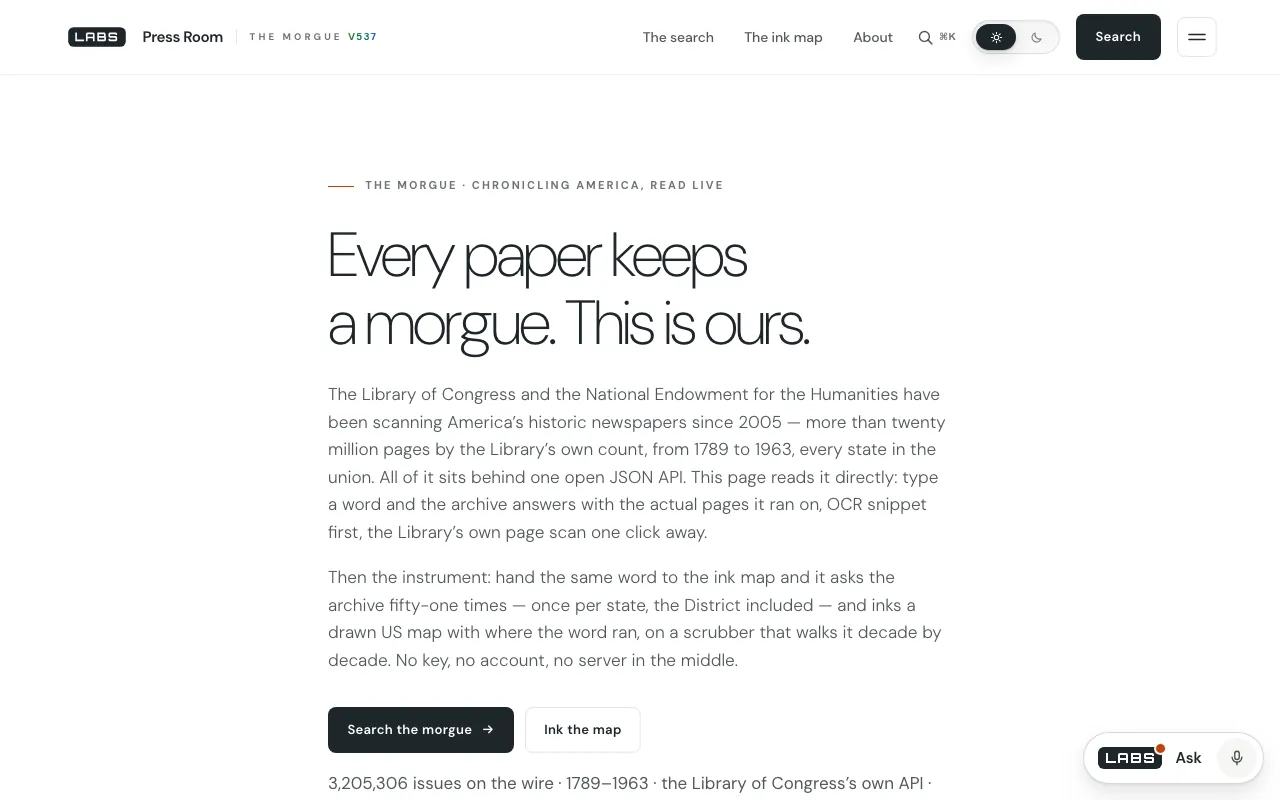
Press Room is a reading room over Chronicling America, the Library of Congress's collection of digitised historic American newspapers. Search a word or phrase and you get newsprint cards that open the page scans; filter by state and by years; or 'ink' a map of the United States by how often a word turns up in each state, decade by decade.
It is for family historians, students, writers and anyone curious how a word travelled through American papers before 1964 — people who want the Library's pages without a subscription.
Chapter two · How it works
Fifty-one questions for one word
There is no server component. Your browser talks directly to the loc.gov JSON interface for the Chronicling America collection, twenty results a sheet, with optional dates.1
The ink map is the ingenious part. One word becomes fifty-one faceted questions, one for each state and one for the District of Columbia, and each carries a dates facet, so the decade scrubber can redraw the map without asking again.2
Then comes the patience. The Library rate-limits, and its refusals arrive without CORS headers, so a browser cannot even read them properly. Press Room spaces the start of each request 1.4 seconds apart, pauses the whole queue for 65 seconds after a refusal, and after three pauses settles for a partial map rather than failing.3 It also reads the interface's arithmetic correctly — 'of' counts page images and 'total' counts result sheets — a reading the code confirmed by checking that facet counts sum to 'of'.4
Your last search is remembered, and inked words are cached in your browser for six hours, ten words at most, so a return visit does not spend fifty-one requests again.5
Chapter three · The test
Twenty-four seconds for one word
We loaded the page from a local copy of build 537 at 19:58:54 UTC on 27 September 2026 (50,226 bytes). At 19:59:49 UTC we made the request the page would make for 'lighthouse'. The Library answered after 24.7 seconds with 86,306 bytes and an open CORS header.
It reported 223,150 hits over 11,158 sheets and returned twenty results. The first card was image 3 of the San Antonio Daily Light for 1 October 1895, linked to the Library's IIIF image service.6
Chapter four · Against the field
The Library's own site, and Newspapers.com
Chronicling America on loc.gov
Page read 27 September 2026, 20:02 UTC, via the Library's research guide
The Library of Congress and the National Endowment for the Humanities publish millions of newspaper pages through 1963, from every state, the District of Columbia, Puerto Rico and the US Virgin Islands, with a viewer for zooming and navigating and downloads as TIFF, JPEG2000, PDF with hidden text and ALTO text.
Where it is betterIt is the authoritative viewer for every page, with archival downloads and documented bulk data.
Where Press Room goes furtherIt turns a word into a state-by-state, decade-by-decade map — a question the collection search answers one query at a time — and paces itself so a visitor is not locked out.7
Newspapers.com
Page read 27 September 2026, 20:02 UTC
Ancestry's commercial archive counted more than 1.25 billion pages from over 31,500 newspapers, 1690 to the present, with person and topic search, a clipping tool, and subscription access after a one-week trial.
Where it is betterA vastly larger archive, including everything after 1963, and clipping tools built for genealogy.
Where Press Room goes furtherIt is free and needs no account; every query is your own browser asking the Library of Congress.
Chapter five · Where it falls short
The cost is patience
Press Room is slow because the Library is slow. Our single sheet took 24.7 seconds, and the code itself records anything from 3 to 32 seconds a query. A full ink map is fifty-one requests spaced 1.4 seconds apart, so at least about seventy seconds before any pause.8
It can search only what Chronicling America holds, which stops at 1963. And it offers no clipping, saving or citation tools beyond the link to each page.
Chapter six · The verdict
A courteous guest in a public archive
Press Room treats a public collection with care. It reads the interface's figures correctly, gets a whole map's worth of history from fifty-one requests, spaces them so the Library is not hammered, and remembers what it has already drawn. The ink map is the reason to come.
Bring patience. For papers after 1963 or for clipping tools, Newspapers.com goes further; for the definitive page viewer, go to the Library itself.
A careful reading room for America's old papers, if you can spare the wait.
Notes on the evidence
Paths are in the labs.llc build 537 tree; times are UTC on 27 September 2026.
press/assets/js/app.jsheader lines 1–5; line 19; lines 78–85.app.jslines 195–199 and 228–230;states.jscarries 51 state keys.app.jsheader lines 9–15; lines 22–24 (1,400 ms gap, 65,000 ms pause, three pauses); line 111.app.jsheader lines 6–9.app.jsline 98; lines 26–27 and 202–225.- Page at 19:58:54 UTC; the loc.gov request for 'lighthouse' (JSON, twenty a sheet) at 19:59:49 UTC.
app.jslines 195–199, 228–240 and 22–24.app.jslines 10 and 25.