A long read · Studio & Tools · Sound
Drums builds every hit from nothing, and says how
A sixteen-step drum machine with eight synthesised voices, a clock built for phones, and a whole groove in a 62-byte link. We read its three scripts and set it beside Drumbit and Splice Beatmaker.
By the LABS editorsTested 27 September 2026, 19:56–20:03 UTCA 4-minute read818 words
Chapter one · What it is
A drum machine with its recipes showing
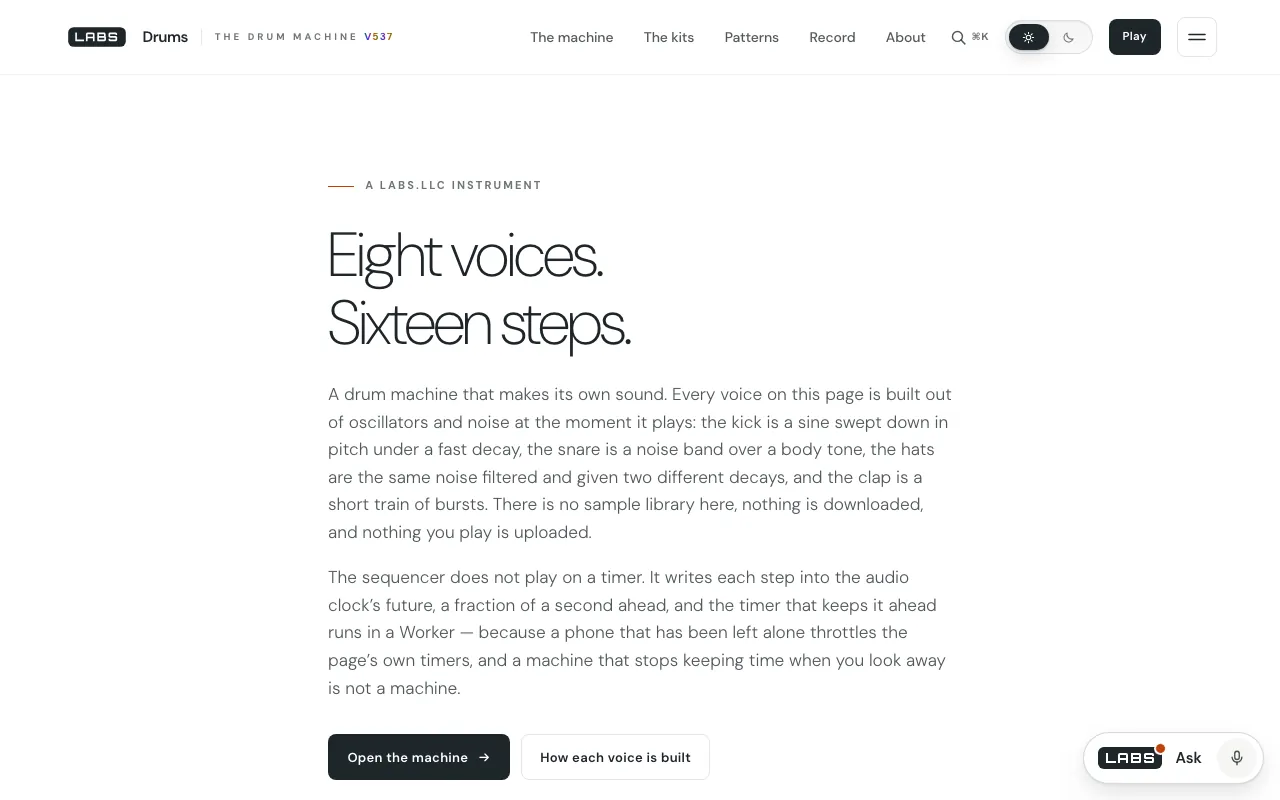
Drums is a sixteen-step drum machine whose eight voices are synthesised as they play. It has swing, tap tempo, eight pattern slots, a recorder, and a link that carries the entire pattern to whoever you send it to.
It is for beginners learning how a beat is put together, producers sketching an idea, and teachers — anyone who wants a drum machine in a tab with nothing to download and no account to make.
Chapter two · How it works
Oscillators, noise, and a clock that looks ahead
There are no samples. kit.js describes itself as having no sample, no fetch and no URL, and builds each voice from oscillators and noise shaped by envelopes, routed through voice buses to a master and out, with the recorder tapped off the master.1 Each voice's recipe is written beside it: the kick is a sine swept from about 160 Hz down to 48 Hz in fifty milliseconds, with a noise transient; the clap is four bursts of noise near 1.1 kHz, about eleven milliseconds apart.2
Timing belongs to clock.js, a lookahead scheduler that writes each step into the audio clock at a sample-accurate time before it is due. Its pump runs twice — from the page and from a two-line Worker — because phones throttle idle page timers and leave a Worker's alone.3 Swing is defined exactly: every odd sixteenth is played late by the swing fraction of one step, with no running total, so the bar never stretches. Tap tempo averages the last eight taps and forgets any gap longer than two seconds.4
machine.js packs the whole machine — tempo, swing, length, kit, every cell and accent, each voice's level, tune and decay, and the mutes — into 62 bytes of base64url. The same encoding fills the slots and the share link, which carries it after #p= in the fragment, the part of an address browsers do not send to servers.5 The recorder, at 192 kbps, reads back the format the browser actually produced instead of assuming it.6
Chapter three · The test
Weighing the machine
At 19:56 UTC on 27 September 2026 we sized the three scripts in a local copy of build 537: clock.js 7,005 bytes, kit.js 25,946 and machine.js 35,397. At 19:58:54 UTC the page itself returned HTTP 200 and 66,235 bytes.
That is about 68 KB of code and not a single audio file — every sound on the page comes from those bytes.
Chapter four · Against the field
Drumbit and Splice Beatmaker
Drumbit
Page read 27 September 2026, 20:03 UTC
Drumbit is a free web drum sequencer with preset kits from Rock and Funk to Bossa Nova, Hip-Hop and House, a sixteen-step editor across four patterns, tempo and swing, a compressor, low- and high-pass filters, a keyboard entry mode, recording, and saving and loading as a drumbit file. It is funded by voluntary contributions.
Where it is betterFour patterns rather than one, a compressor and filters on the output, and genre kits ready to play.
Where Drums goes furtherIt carries its whole state in a 62-byte link fragment, so there is nothing to save as a file and nothing sent to a server, and it explains each voice as synthesis in plain words beside the grid.7
Splice Beatmaker
Page read 27 September 2026, 20:03 UTC
Splice's free browser beatmaker offers a 32-step grid of real drum samples, any tempo from 60 to 240, featured beats by named producers, sharing by link and a free MIDI download of the pattern. Saving and loading beats needs a Splice account, and more sounds need a subscription.
Where it is betterProfessionally recorded samples, twice the steps, and MIDI export.
Where Drums goes furtherIt keeps your work without an account, in eight local slots and a self-contained link, and its Worker-driven second pump is engineered for phones.8
Chapter five · Where it falls short
One pattern, eight voices, no MIDI
Drums plays a single pattern of up to sixteen steps. There is no song arrangement, no chaining of patterns, no per-step probability and no MIDI — and the page says so itself.9
It is not a sampler: eight synthesised voices are all you get, where Splice offers producer kits of real recordings. And latency is whatever your browser and device provide; on a phone, the page admits, you can feel it when tapping along.
Chapter six · The verdict
Small, exact and entirely yours
Drums goes to the length of building every sound from arithmetic and publishing the recipe, of engineering its clock around the habits of phone browsers, of defining swing to the step, and of fitting a whole groove into a link the server never sees. It is a teaching instrument as much as a toy, and a good one.
When you need real samples, longer patterns or MIDI, Splice Beatmaker and Drumbit go further.
A beat machine that shows you how every sound is made, then lets you keep it.
Notes on the evidence
Paths are in the labs.llc build 537 tree; times are UTC on 27 September 2026.
drums/js/kit.jslines 1–6 and 8–22.kit.jslines 42–58 (the voice table).drums/js/clock.jslines 1–18; the Worker at line 52.clock.jslines 60–65 (swing) and 136–157 (tap tempo).drums/js/machine.jslines 40–62 and 499–518;drums/index.htmllines 915–920.machine.jslines 567–572 and 595–598.machine.jslines 40–62 and 499–518;kit.jslines 42–58.machine.jsline 15 (slots);clock.jslines 9–18 and 52.drums/index.htmllines 903–913.