A long read · Studio & Tools · Design
DMT makes chance repeatable
A generative art lab with forty-nine composition algorithms, a seed that replays any piece, and a recorder that asks for 60 Mbps. We counted its tables and set it beside Silk and Hydra.
By the LABS editorsTested 27 September 2026, 19:58–20:06 UTCA 4-minute read862 words
Chapter one · What it is
Pictures you can steer and keep
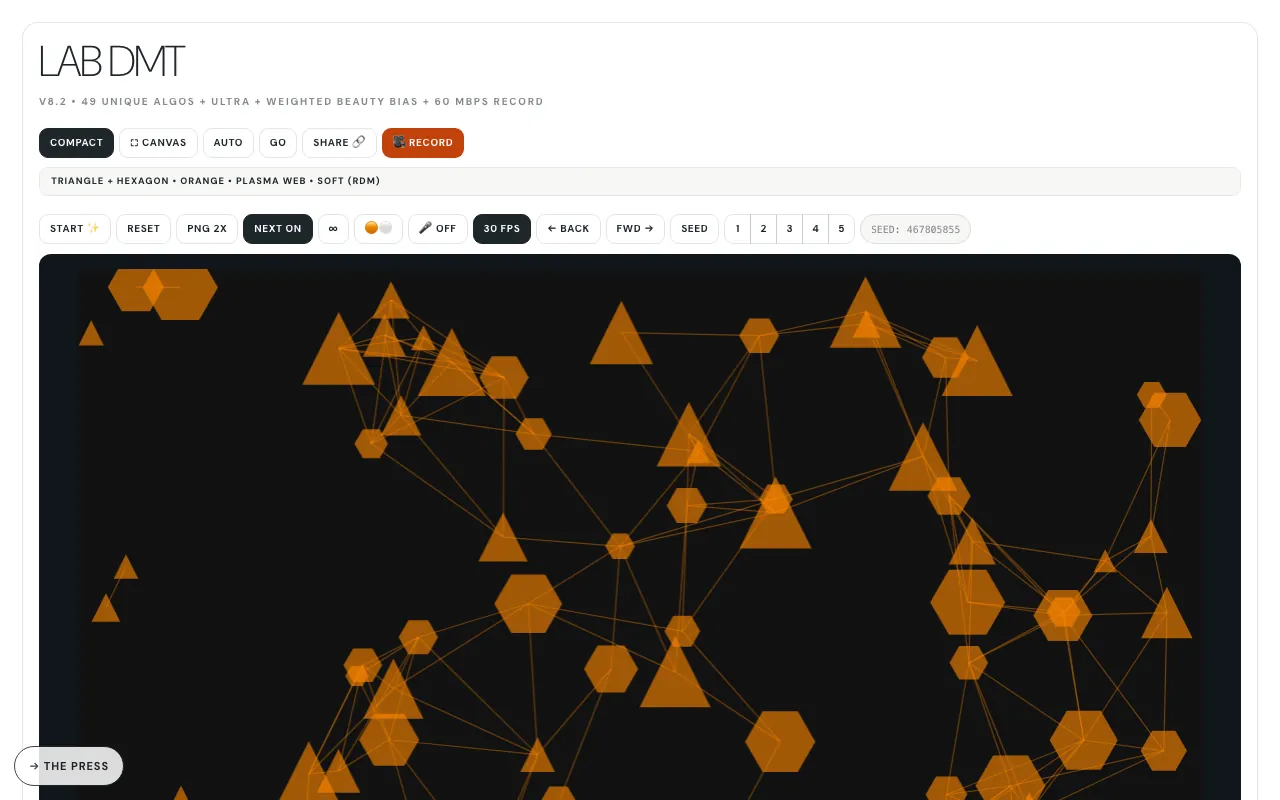
DMT is a procedural geometry lab on labs.llc. Shapes are arranged on a canvas by one of forty-nine composition algorithms; you can let it run, steer it, freeze a moment, share a preset as a link, or record the result as video. Some modes react to a microphone.
It is aimed at visual artists, VJs and designers — anyone who wants generative art that moves, that can be replayed exactly, and that needs no code.
Chapter two · How it works
One page, one seeded generator
The whole engine lives inside one page, drawn to canvas in the browser. Nothing is fetched for the art; the only network request in the page belongs to its contact form.1
Its most careful part is its randomness. A seed is hashed once into 128 bits and fed to an sfc32 generator, with independent salted sub-streams for different decisions, and picks are made with a seeded Fisher–Yates shuffle.2 The comments explain why: the old habit of adding a counter to the seed made neighbouring seeds into shifted copies of each other. Now a seed replays a composition exactly and the next seed along is genuinely different.
Above that sits what the page calls a beauty engine, with three strategies. HARMONIA chooses colour relationships first — triads, split complements, analogous sets. GOLDEN walks an eight-dimensional composition space by a low-discrepancy sequence, so consecutive pieces do not clump. EVO keeps a population of fourteen compositions and breeds them by tournament selection, crossover and decaying mutation, steered by the pieces you keep.3
A preset is the full state as base64 JSON in the ?p= query, loaded through the same path as the undo history.4 The recorder captures the canvas at 60 frames a second and asks MediaRecorder for 60,000,000 bits a second, preferring WebM VP9 and then MP4, and names the file after the container it actually received.5
Chapter three · The test
Counting the tables
We requested the page from a local copy of build 537 at 19:58:54 UTC on 27 September 2026: HTTP 200 and 367,539 bytes of HTML, with the whole engine inline. At 20:06 UTC we counted its tables in the served source.6
The algorithm table holds 49 named entries, matching the '49 unique algos' in the page's own description. The shape table holds 21, where the description says 20; two of the 21 are slots for your own images, so the difference is one of counting rather than substance.
We did not measure the bitrate of a finished recording, and that leads to the first caveat in chapter five.
Chapter four · Against the field
Silk and Hydra
Silk
Page read 27 September 2026, 20:02 UTC
Silk, by Yuri Vishnevsky, turns a drag of the pointer into flowing strands, with mirror and spiral symmetry, undo, a choice of colour, and music and sound by Mat Jarvis. You keep a piece by saving its thumbnail image, and art shared through Silk carries a Creative Commons licence.
Where it is betterIt is instant and lovely with almost nothing to learn, and the art follows your hand.
Where DMT goes furtherIts forty-nine algorithms and seeded replay mean a piece can be regenerated exactly from a number, and it records moving video at a requested 60 Mbps where Silk saves a still image.7
Hydra
Page read 27 September 2026, 20:02 UTC, via its documentation
Hydra is a free, open-source video synth and live-coding environment that runs in the browser and compiles to WebGL. Its documentation describes chaining transformations like an analogue synthesiser, mixing camera, screen-share and video sources, audio-reactive visuals, streaming between browsers, and a community gallery.
Where it is betterCode gives Hydra unlimited range; it renders on the GPU, takes live video inputs, and is open source.
Where DMT goes furtherIt needs no code at all — the beauty engine chooses palettes and structures, and in EVO mode learns from what you keep — and it ships a high-bitrate recorder and one-link presets.8
Chapter five · Where it falls short
A request is not a guarantee
The 60 Mbps figure is what DMT asks the browser's encoder for; the code never reads back the bitrate it got, so the number describes intent rather than output.
Because the recorder prefers VP9, a recording made in Chrome is a WebM file, which Apple devices will not open without conversion; MP4 is used only when VP9 is unavailable.9
Browsers that cannot record get a blocking alert box rather than a message in the page. And DMT is not programmable: there is no code layer, no camera or video input to mix, and no streaming between browsers.
Chapter six · The verdict
An instrument for repeatable accidents
DMT goes to real lengths to make randomness trustworthy: a rebuilt generator so that seeds replay and neighbours differ, three stated strategies for choosing what looks good, and a recorder that asks the browser for 60 Mbps. For no-code generative video that you can reproduce and share, it is unusually thorough.
If you want to draw by hand, Silk is simpler and lovelier. If you want to write the visuals yourself, with cameras and shaders, Hydra is the deeper instrument.
Generative art you can reproduce from a number, no code required.
Notes on the evidence
Paths are in the labs.llc build 537 tree; times are UTC on 27 September 2026.
dmt.phpline 6741 (the contact form).dmt.phplines 1366–1430 (seed hash and sfc32) and 1434–1445 (seeded shuffle).dmt.phplines 5081–5088, 5137–5143 and 5173–5182; modes at line 5554.dmt.phplines 2713, 2717–2720 and 2970–2979.dmt.phplines 3265–3275 and 3283–3288.- Tables at lines 1488–1510 (shapes, 21) and 1512–1562 (algorithms, 49); description at line 186.
dmt.phplines 1512–1562, 1366–1430 and 3265–3275.dmt.phplines 5081–5182, 2717–2720 and 3265–3275.dmt.phplines 3268–3269; the alert at line 3261.