A long read · Live Intelligence · Earth
Aurora reads NOAA itself, and shows its working
A space-weather page that fetches three raw NOAA feeds every five minutes. We timed them on a quiet evening and set the page beside NOAA's own product and SpaceWeatherLive.
By the LABS editorsTested 27 September 2026, 19:58–20:01 UTCA 4-minute read829 words
Chapter one · What it is
A desk for people who watch the sky
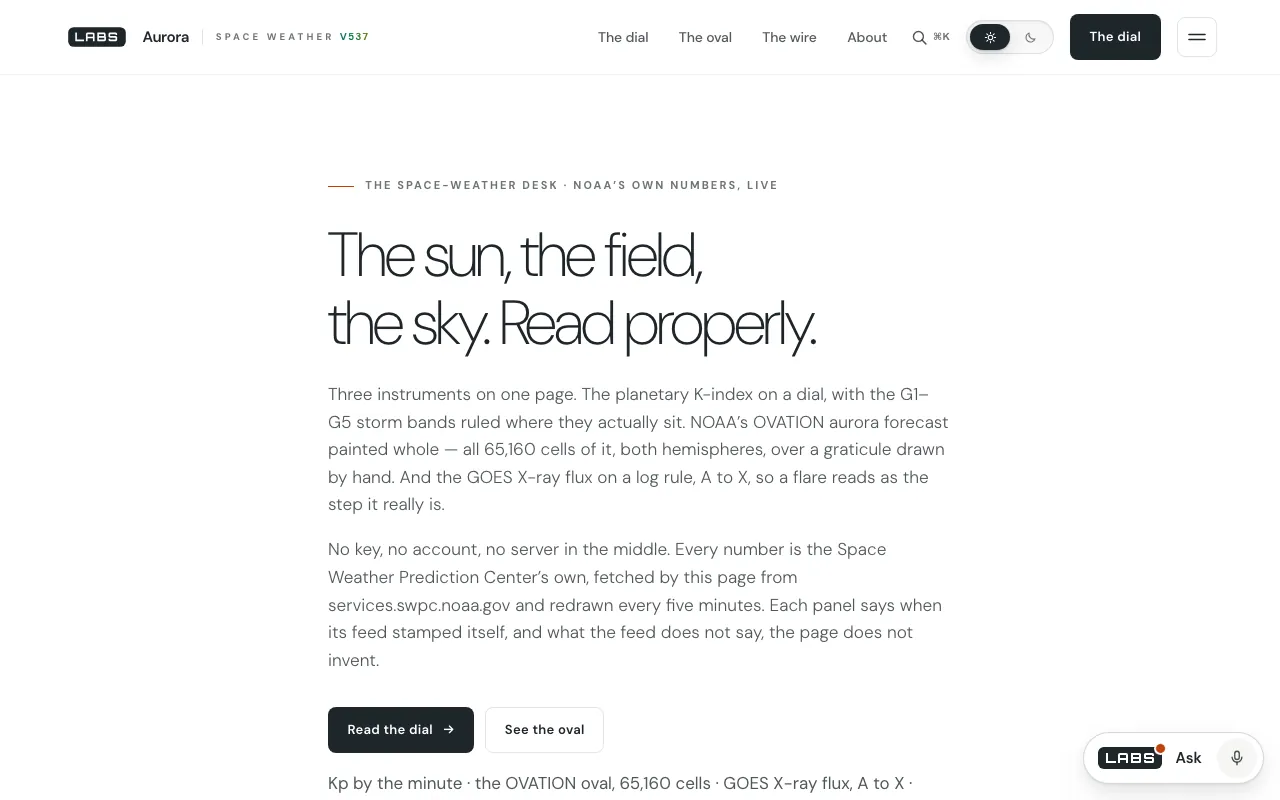
Aurora is a single page on labs.llc for anyone who has stood in a cold field wondering whether tonight is the night. It puts three NOAA measurements on one screen: the planetary K-index as a dial ruled with the G1 to G5 storm bands; the OVATION aurora model painted cell by cell over a world map; and a GOES satellite's X-ray flux, sorted into flare classes.
It is for aurora chasers who want the agency's own numbers without an app, an account or adverts, and for anyone curious whether the field is quiet or storming.
Chapter two · How it works
No relay in the middle
Everything happens in your browser. The script asks services.swpc.noaa.gov directly for three JSON files — Kp by the minute, the OVATION grid and GOES X-rays — with caching off and a fifteen-second limit on each.1 No labs.llc server sits in the path; NOAA lets any site read these feeds, as the open CORS header we saw confirmed.2 It reads again every five minutes, and when a hidden tab returns to view.3
The OVATION file arrives as 65,160 separate cells of longitude, latitude and probability. Aurora packs them into one 360 by 181 grid, finds the strongest cell in each hemisphere, rings it on the canvas and names its coordinates beneath.4
Storm levels are named only once Kp reaches 5; below that, the index is shown exactly as filed.5 Every panel carries its own read time, and a failed fetch is announced as an alert rather than passed over in silence.6
Chapter three · The test
A quiet evening, measured
At 19:58:54 UTC on 27 September 2026 the page, served from a local copy of labs.llc build 537, returned 55,761 bytes. Fifteen seconds later we requested the three NOAA files the script asks for.
The Kp feed held 357 one-minute rows ending at 19:55 UTC, with an estimated Kp of 0. The OVATION file weighed 918,537 bytes and contained exactly 65,160 cells; the strongest northern cell was 12% at 69°N, the strongest southern one 13% at 62°S. The latest GOES-18 X-ray reading, at 19:56 UTC, was 4.28 × 10⁻⁷ W/m², which the page's own bands class as B.7
Nothing much was happening, and a page reading these files had to say so. Aurora's code has no way to round a zero up into excitement: Kp 0 is drawn as Kp 0, and a 12% peak is ringed and named as 12%.
Chapter four · Against the field
NOAA's own page, and SpaceWeatherLive
NOAA SWPC Aurora – 30-Minute Forecast
Page read 27 September 2026, 20:01 UTC
This is the forecaster's own product page for the OVATION model. It draws separate northern and southern hemisphere maps, keeps the last 24 hours of frames for animation, explains the OVATION 2020 model and its 30-to-90-minute lead time, and offers the grid as JSON alongside the Hemispheric Power Index.
Where it is betterPolar maps suit an oval centred on the pole, the frames show the aurora moving, and the model is explained by those who run it.
Where Aurora goes furtherIt puts Kp, the aurora grid and the X-ray flux on one page, each with a read time, where NOAA gives one product per page;8 and it names the strongest cell for the hemisphere you pick, then remembers the pick.
SpaceWeatherLive
Page read 27 September 2026, 20:01 UTC
SpaceWeatherLive credits NOAA SWPC for its predictions. Its aurora page offers a three-day Kp forecast, probability figures for high and middle latitudes, a 27-day outlook, instant alerts, mobile apps and an ad-free paid tier.
Where it is betterIt looks ahead, and it will alert you when conditions change.
Where Aurora goes furtherIt reads the minute-by-minute Kp estimate and the live OVATION grid itself, redrawing every five minutes, rather than a forecast summary refreshed daily; and it has no adverts and no paid tier.9
Chapter five · Where it falls short
It cannot see tomorrow, or wake you
Aurora is a nowcast. It has no three-day or 27-day Kp outlook, although NOAA publishes both and SpaceWeatherLive displays them — the figure a trip north is planned on.
It has no alerts either: it reads only while the tab is open, so nothing will tell you that Kp crossed 5 while you slept.
Its map is a flat world canvas at the grid's own 360 by 181 resolution, not NOAA's polar projection, so the oval stretches near the pole, where the aurora lives.
Chapter six · The verdict
Honest numbers for the present tense
Aurora's achievement is restraint. It fetches NOAA's raw measurements from your own browser, shows all 65,160 OVATION cells at their native resolution, names the strongest, and stamps every panel with the moment it was read. On a dead-calm evening it said, in effect, dead calm.
Use it to see what the sun and the field are doing now. For anything further ahead, or for a nudge in the night, open NOAA's forecast page or SpaceWeatherLive.
Space weather in the present tense, with the working shown.
Notes on the evidence
Paths are in the labs.llc build 537 tree; times are UTC on 27 September 2026.
aurora/assets/js/app.jslines 1–11 and 15;fetchJSON, lines 60–69.- The open CORS header on the Kp feed, at 19:59:09 UTC.
app.jsline 16 (REFRESH_MS300000) and line 471 (read again on tab focus).app.jslines 224–238, 250–258 and 312–318; the pick is kept at 324–329 and 445–453.app.jslines 104–116, with NOAA's storm names from line 20.app.jslines 118–124 (read stamp) and 50–57 (errors markedrole=alert).- Page at 19:58:54 UTC; feeds at 19:59:09 UTC. Flare bands:
app.jslines 21–24. app.jslines 1–11 andrefresh(), lines 71–100; the pick, 324–329.aurora/index.htmlline 550;app.jslines 15–16.